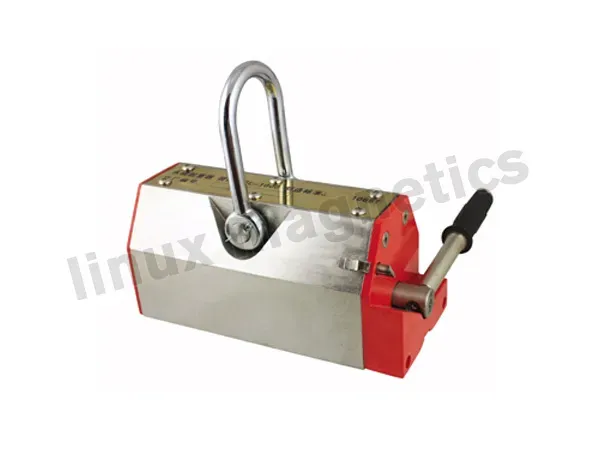
Rated capacity is a starting point
The capacity marked on a lifting magnet assumes ideal conditions: clean, flat, low-carbon steel thick enough to carry all the magnetic flux. Real loads are often thinner, rough, painted or scaled, or made of alloy steel, and each of these lowers the holding force. Always choose a magnet with a margin above the actual load weight.
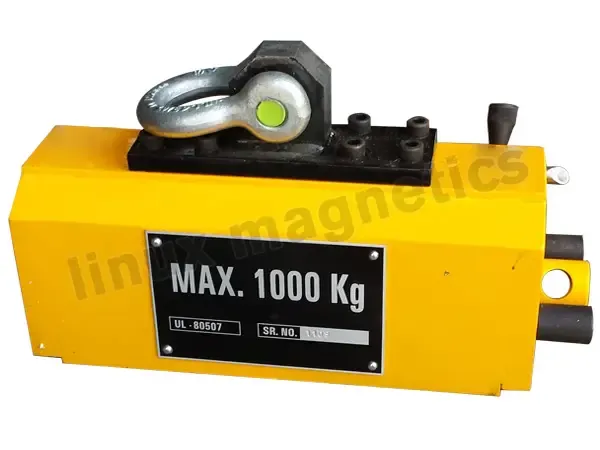
Steel thickness and contact
Thin plates cannot absorb all the flux, so holding force drops. Air gaps from rust, paint or uneven surfaces have the same effect. Clean the contact area and keep the magnet's pole face flat and undamaged.
Safe working habits
Check the lever is fully locked before lifting. Never lift over people. Lift only one plate at a time unless the magnet is designed for it. Inspect the magnet regularly for damage.
Long plates and bars
Use two or more magnets on a spreader beam so long loads stay level and do not peel away from a single magnet.
Key features of our lifting magnet
- Guidance on capacity margins
- Permanent, power-free lifting
- Spreader beam configurations
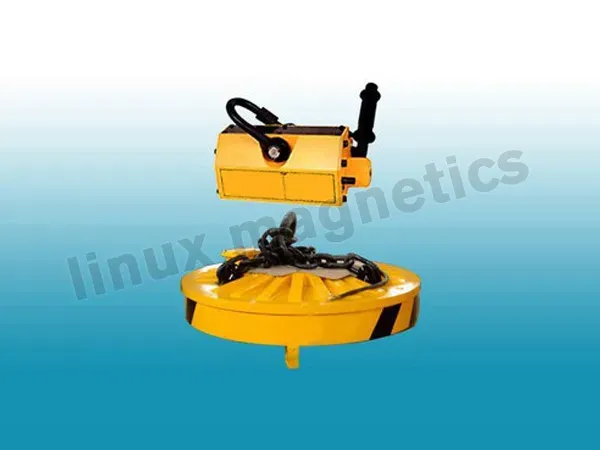
- Flat and round steel models
Applications & industries
- Workshops
- Fabrication
- Steel service centres
- Machine shops
Lifting Magnet at a glance
| Lifting | Permanent magnet |
|---|---|
| Configuration | Single or multi-magnet beam |
| Inputs | Load weight, size, thickness, surface |
Exact dimensions, capacity and magnet strength are confirmed against your application before manufacture.
Need a lifting magnet for your plant?
Send your material, capacity and installation details for a quotation.
Frequently asked questions
Why is my lifting magnet weaker on thin plate?
Thin steel cannot carry all of the magnet's flux, so the holding force is lower than the rated capacity.
Can a lifting magnet be used on stainless steel?
Most austenitic stainless steels are non-magnetic and cannot be lifted reliably.